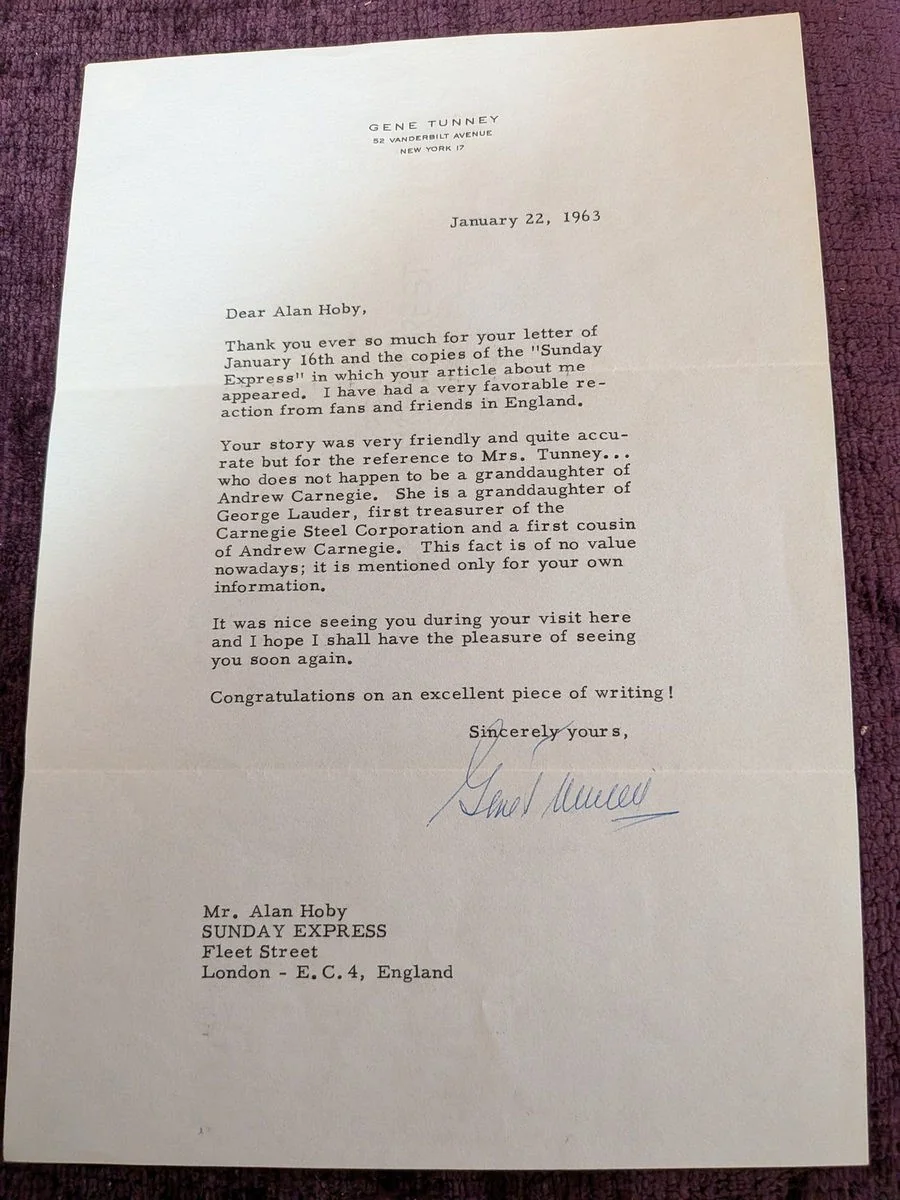
On 22 January 1963, Gene Tunney wrote to boxing journalist Alan Hoby of the Sunday Express. The former world heavyweight champion had been retired for more than three decades. His victories over Jack Dempsey belonged to another age, but his place in boxing history was secure.
The letter thanked Hoby for a favourable article and made a personal reference to his wife’s family connection with Andrew Carnegie. Nothing particularly extraordinary about that. A retired champion responding to something written about him.
Yet more than sixty years later, the letter survives. So does its original envelope, bearing a New York postmark from March 1963. Together, they preserve something no record of Tunney’s victories could ever provide: a small, ordinary exchange between two people connected by boxing.
The signature is interesting. The words are more interesting. But the fact that somebody thought to keep the letter, and that others subsequently preserved it, is what allows us to examine it today.
That is the part of collecting which interests me most. Not simply who signed something, or what it might be worth, but what it can tell us — and what would disappear if nobody bothered to keep it.
The history between the results
Boxing is a sport obsessed with records. We know who won, who lost, which titles changed hands and how many rounds a contest lasted. We can debate champions who fought generations apart until the early hours.
Those records matter. Without them, there is no reliable framework for the sport’s history. But they are only part of it.
A fight record does not tell us what a spectator paid to enter the hall. It rarely tells us how a local promoter presented an evening’s entertainment, which advertisements appeared in the programme, or what a retired champion thought when a journalist wrote something kind about him.
Those details live elsewhere. In old programmes. In letters. In photographs, tickets, magazines and the things people brought home and put away. Some were kept because they were treasured. Others probably survived because nobody got around to throwing them out.
Something does not become historically significant merely because it is old, signed or expensive. Its usefulness depends on what it records, how confidently we can identify it and whether the information attached to it can be trusted. That is where collecting becomes something more than ownership.
A letter, an envelope and a correction
The Tunney letter is a good example of why context matters. Tunney held the world heavyweight championship from 1926 to 1928, defeating Jack Dempsey twice before retiring as champion. His career has been examined extensively.
The 1963 letter tells us very little about his fighting achievements. It tells us something about the man who came afterwards. He was corresponding with a British boxing journalist, acknowledging an article and making a personal observation. There is no great revelation. And that is precisely why I find it interesting.
The letter also carries a warning about accepting information at face value. An earlier catalogue entry incorrectly recorded its date as 1961. Examination of the letter and envelope established 1963 as the correct year.
A small mistake, perhaps. But leave it uncorrected, and the next person might repeat it. Then somebody else might copy that description. Before long, an error has acquired the appearance of an established fact.
A good record tells us what we know, how we know it and what remains uncertain. The envelope, postmark, contents and later authentication paperwork provide different pieces of supporting evidence. None should be mistaken for absolute proof on its own. Together, they make the document more useful than an isolated signature.
Jack Dempsey after the cheering stopped
Jack Dempsey is remembered as one of the great heavyweight champions of the twentieth century. His victory over Jess Willard in 1919 began a reign that helped establish boxing as a major public spectacle.
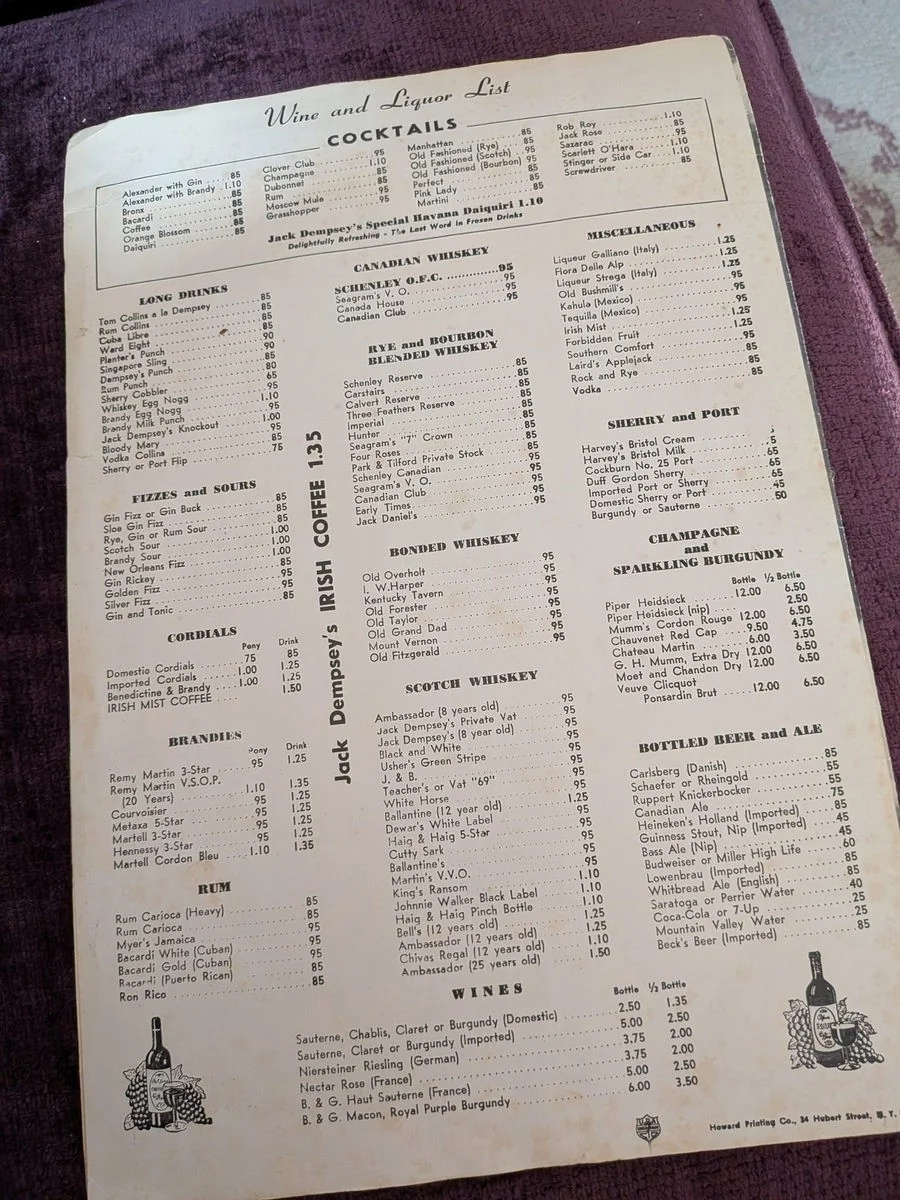
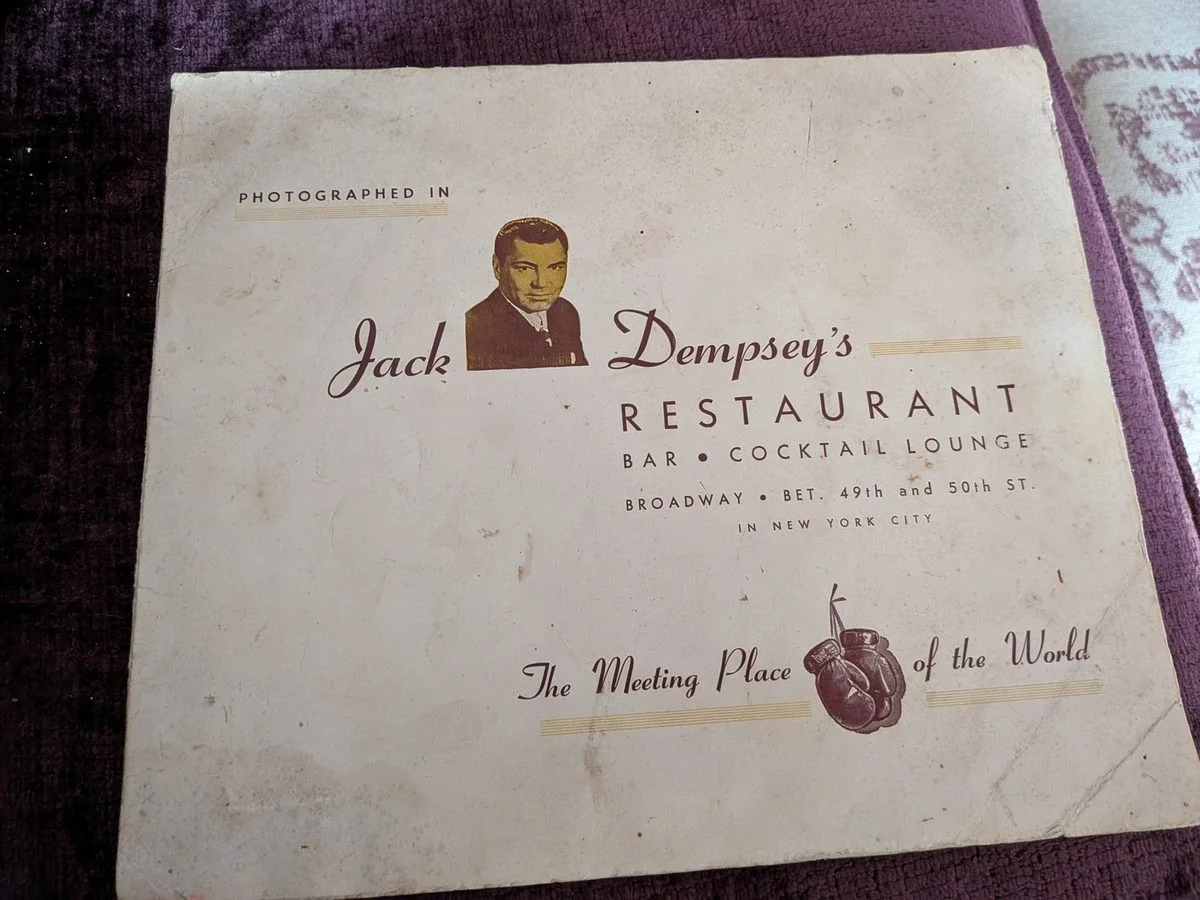
But Dempsey had another public life after boxing. He became closely associated with his New York restaurant, where visitors could encounter a former champion in surroundings very different from those in which he made his name.
A surviving menu from Jack Dempsey’s Broadway restaurant, dated 22 January 1968, carries his signature and a handwritten greeting. Look beyond the autograph: the menu records the restaurant’s address, its branding and what customers could order on that particular evening.
A separate souvenir photograph shows him with restaurant patrons. It survives in its original folding presentation folder, with information about the photographic service and a companion image commemorating his championship victory over Willard.
The folder is not merely packaging. It explains the photograph. Remove it, discard it or separate the accompanying print, and some of that context is lost. Sometimes the apparently secondary things carry the information that makes the principal object understandable.
When boxing began formally honouring its past
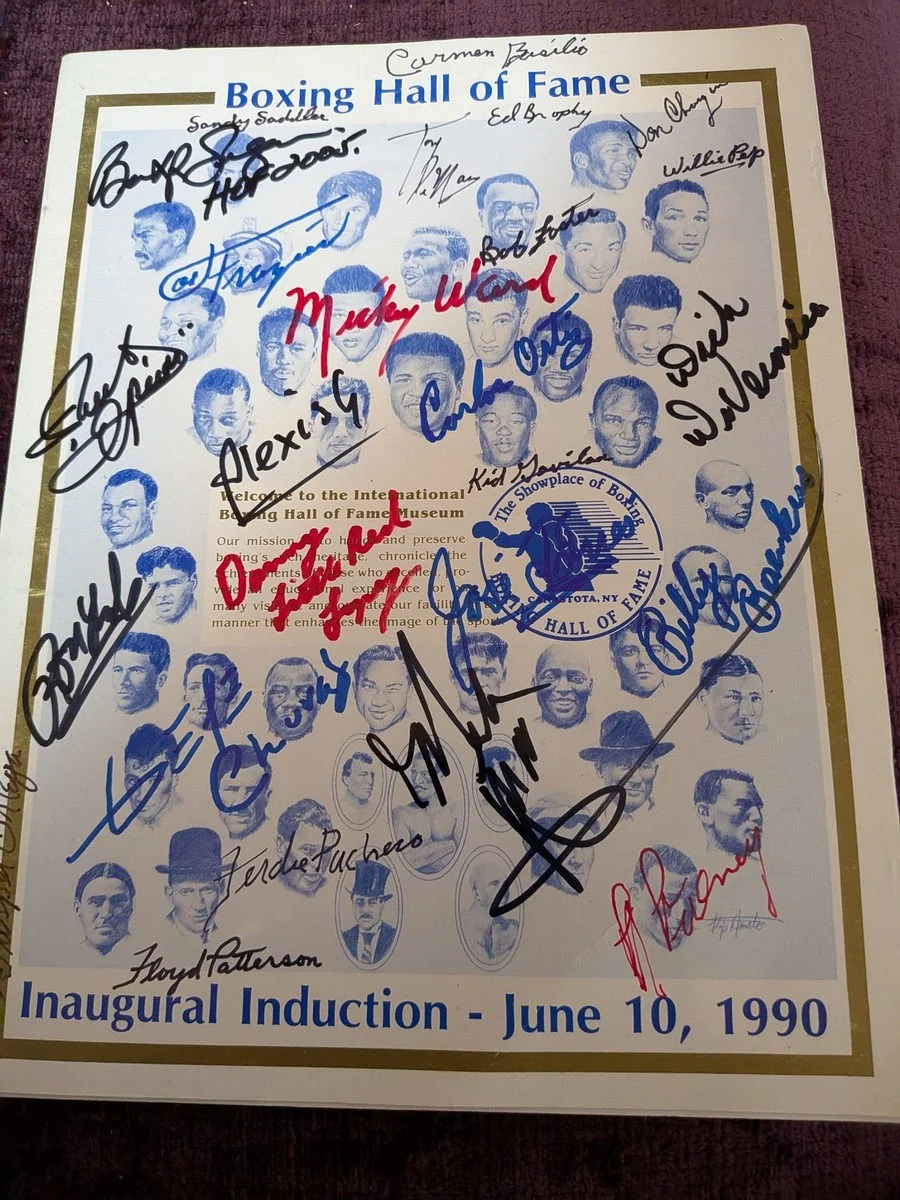
In 1990, the International Boxing Hall of Fame held its inaugural induction weekend in Canastota, New York. An original programme from that occasion survives with twenty-five signatures.
At first glance, it is the names that command attention. That is understandable. But the programme itself matters: it records an occasion when boxing gathered to recognise its own history, and how the sport presented those achievements at that moment.
The signatures add another layer, provided we are careful about identifying them and establishing how they were obtained. The ownership history of this example can be traced through collectors connected with Hall of Fame induction weekends. That information deserves to remain with the object.
A signed programme is not automatically more historically useful than an unsigned one. An original fight programme can preserve the supporting bill, the promoter, the venue, contemporary advertisements and the language used to sell the contest. Those details were recorded before the result became history. We know how the story ended. The people who bought the programme did not.
Fifty small pieces of boxing history
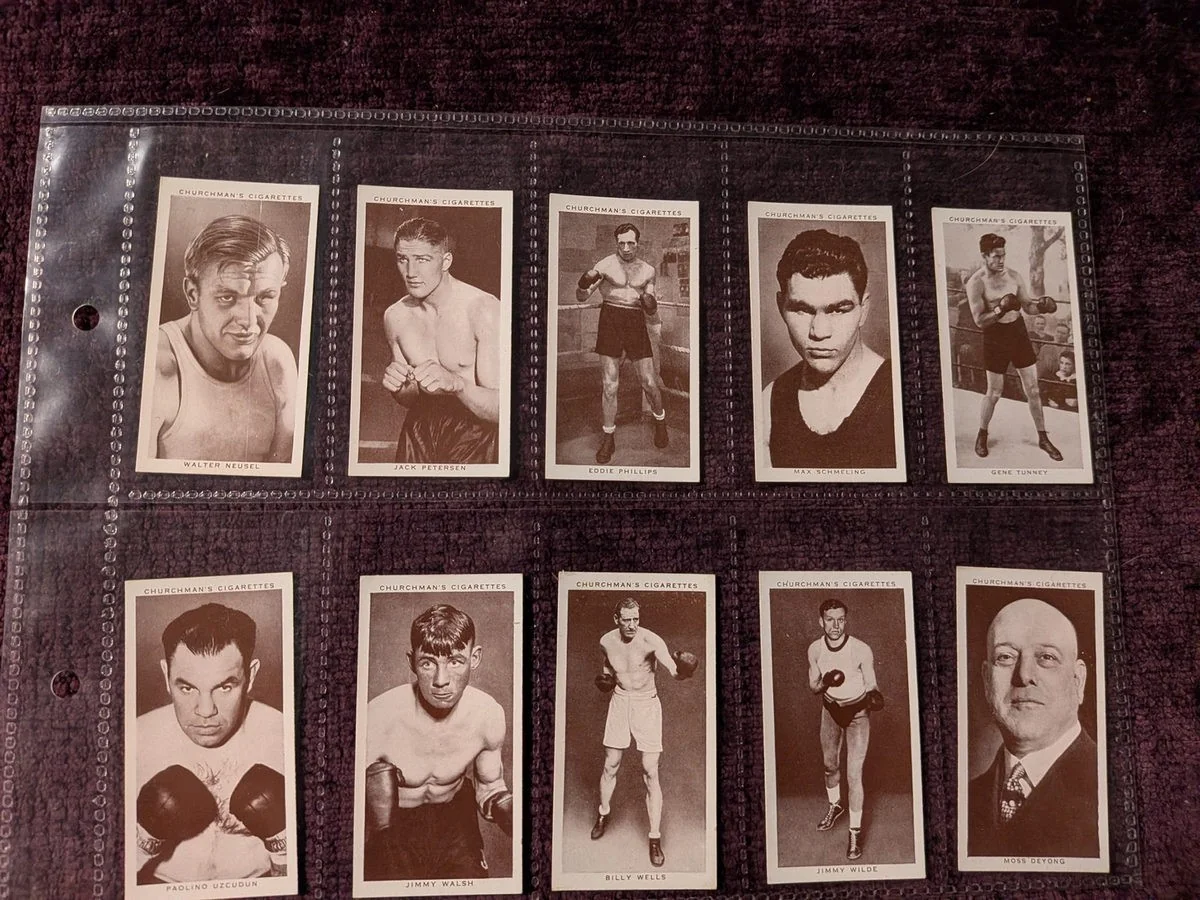
In 1938, W. A. & A. C. Churchman produced a set of fifty cigarette cards titled Boxing Personalities. They were small, mass-produced objects intended to be collected by the public.
The cards included prominent fighters and figures whose roles extended beyond the ring. Photographs on the front and brief biographical information on the reverse show how boxing personalities were presented to the public at the time.
Which people were considered important enough to include? How were their achievements described? Who appeared alongside the champions, and who was left out? Those questions turn modest cigarette cards into useful historical sources.
There is something pleasing about an object originally produced to encourage cigarette sales now helping somebody understand boxing history. I doubt that was what its publishers had in mind.
The people who never reached the headlines
For every world championship contest that generated pages of newspaper coverage, there were countless evenings of boxing in smaller halls and local venues. Some produced future champions. Most did not. But those evenings mattered to the people involved.
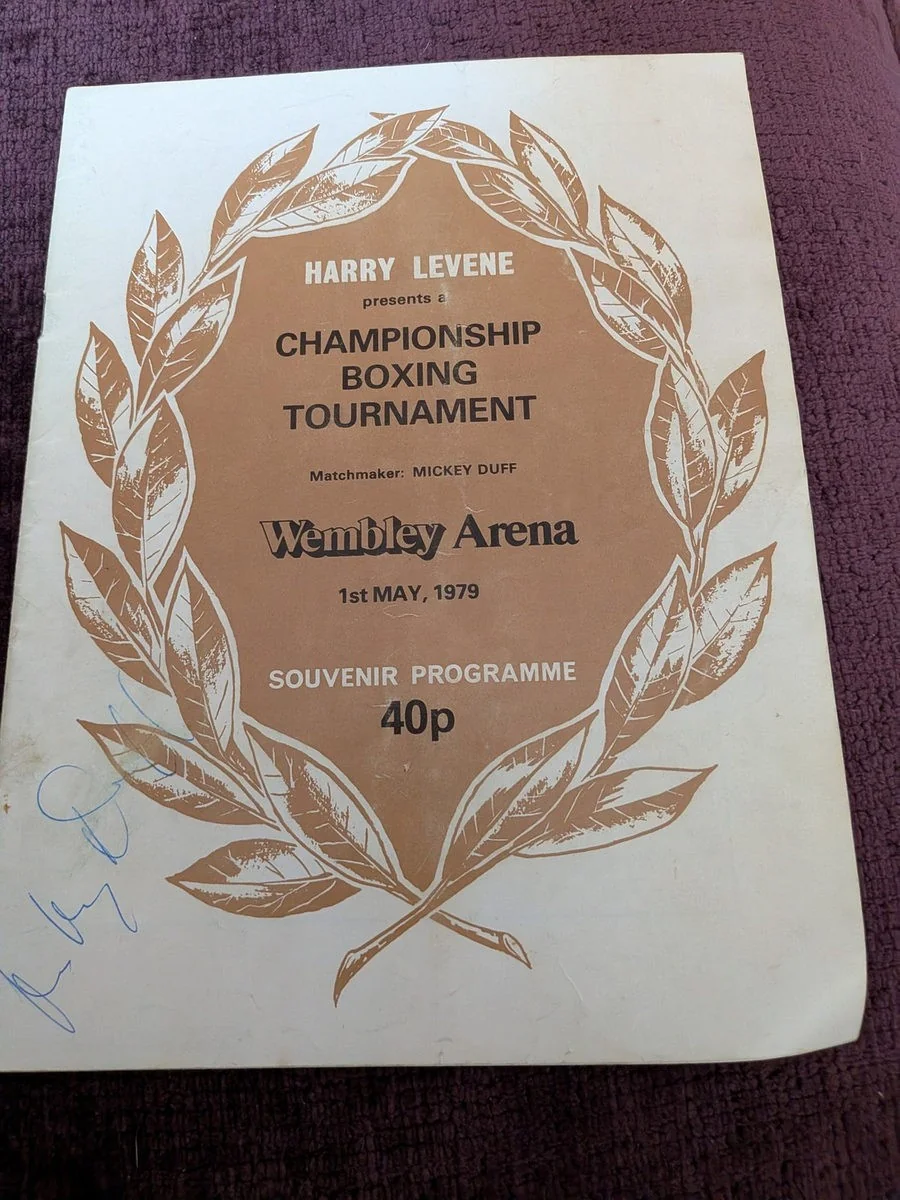
A signed Harry Levene championship boxing tournament programme is an example of material that can preserve this wider world. It may contain names that went on to achieve great things and others that barely appear in later histories.
They trained, competed, entertained crowds and formed part of the sporting life of their communities. Memories are fragile, and time is not particularly kind to details. When a club closes, an official dies or a box of programmes is discarded, part of that local record may go with it.
Not every programme contains a major discovery. Some confirm only that an event was advertised or that a boxer was scheduled to appear. To prove the contest took place, we need corroboration. Even so, the programme may be exactly the evidence a researcher needs.
A collection of names, a community of people
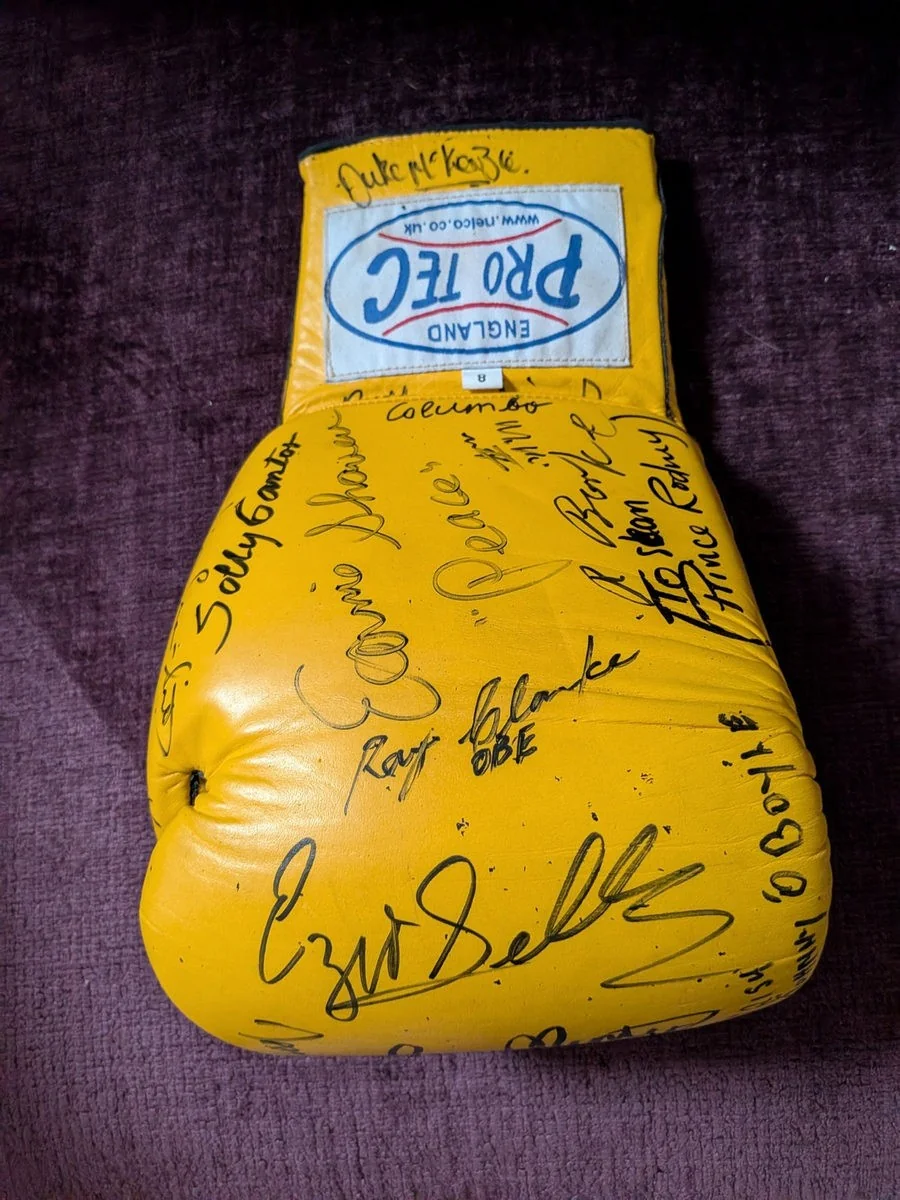
A pair of yellow Pro-Tec gloves carrying numerous signatures offers a different historical connection. Associated with London and Croydon ex-boxers’ organisations, they represent the continuing community around boxing.
Fighters retire. Their records are completed. Their names gradually move from current reporting into the historical record. But many remain involved in the sport, its charitable organisations, reunions and social networks.
Objects signed at gatherings can bring together people whose careers unfolded at different times and levels. There is value in that connection. Not necessarily financial value. Historical and human value.
Of course, a collection of signatures is only as useful as the accuracy of its identification. Where names are unclear, record them as uncertain. Where circumstances are known, keep those details. I would rather leave a question unanswered than give a future researcher a confident answer that turns out to be wrong.
The danger of losing the story
Think about what happens when a lifelong collector dies. Perhaps they spent forty years acquiring photographs, programmes, letters and signed objects. They knew who signed a glove, where a photograph was taken and why a handwritten inscription mattered.
Then the collection changes hands. It might pass to family, be sold or be divided into separate lots. There is nothing inherently wrong with that. The problem is what happens to the knowledge.
If nobody wrote anything down, a signed photograph becomes an unidentified picture. A letter is separated from its envelope. A programme loses the story of how its signatures were collected. The objects survive. The information does not.
A proper collection record need not be expensive or complicated. Photographs, descriptions, dates, ownership history, supporting documents and honest notes about uncertainty can make an enormous difference. If an identification changes, record the correction. If an item has not been authenticated, say so.
Paper, ink and photographs also need appropriate physical care. But conservation is only half the responsibility. The other half is preserving what we know.
What we leave behind
I understand the attraction of owning something connected with a fighter you admire. There is a particular pleasure in holding an original programme from a famous contest or seeing a familiar signature written by the person themselves.
But the longer I spend researching boxing history, the more interested I become in the things surrounding the famous names. The forgotten opponent. The local club. The handwritten dedication. The journalist receiving a letter from a retired champion. The spectator who kept a programme long after the evening was over.
These are the details that give the record books their human dimension. And they are not guaranteed to survive.
We may own the objects, but we do not own the history they represent. We are simply looking after a small part of it for a while. If we do that properly, somebody coming after us will have more than a collection of old paper, photographs and signatures.
They will have the evidence, the context and, where it can still be recovered, the story. Because a signature tells us who held the pen. Preserving the history means remembering why it mattered.