World boxing has never been short of belts.
World titles. Interim titles. International titles. Continental titles. Belts created for a single night.
The Lonsdale Belt is different.
Its territory is smaller.
Its history is deeper.
For more than a century it has represented the British championship — and, for those who earn one outright, something rarer.
It becomes theirs.
That distinction is the key to understanding it.
Before The Belt
British boxing did not begin in 1909.
Nor did the idea of a British champion.
What the National Sporting Club attempted that year was something more organised.
Championship claims existed, but there was no single universally accepted system for deciding who held them. The National Sporting Club, based in Covent Garden, sought to impose order.
Its answer was a series of championship trophies attached to recognised weight divisions.
The Club's president, Hugh Lowther, 5th Earl of Lonsdale, gave his name to the prize that followed.
The Lord Lonsdale Challenge Belt was not merely decoration.
It was trophy, championship system and assertion of authority.
If the National Sporting Club decided who fought for its belts, it also decided whom it recognised as champion of Britain.
That gave the object its power.
Freddie Welsh And The First Belt
The first contest for the new belt took place on 8 November 1909.
Freddie Welsh of Pontypridd faced Johnny Summers for the British lightweight championship at the National Sporting Club.
Welsh won on points after twenty rounds.
The belt system expanded across the recognised divisions, giving British championship status a physical symbol.

The early belts were valuable objects. The National Sporting Club's conditions required the holder to insure the trophy against theft and fire for £200 and lodge security with the Club.
But the greater value was not the metal.
The holder could claim something British boxing badly needed:
recognition.
Winning It — And Owning It
Originally, the belt remained a challenge trophy.
A champion held it.
He did not necessarily own it.
Under the National Sporting Club's conditions, a boxer could make the belt his permanent property by winning three championship contests under the Club's auspices, whether consecutive or not.
There was another route.
If no challenger emerged and the champion remained undisputed holder for three consecutive years, the belt could become his.
Once undisputed owner, the boxer was also entitled to a pension of £1 a week for life from the age of fifty.
The belt was therefore more than a trophy.
It was recognition, property and — at least in principle — a small measure of security after boxing.
The pension arrangement belonged to the original National Sporting Club system.
The idea of outright ownership survived it.
What Does “Outright” Mean?
It remains one of the most misunderstood phrases in British boxing.
Winning the British title does not automatically mean owning a Lonsdale Belt outright.
The Board awards the challenge belt for a British Championship.
Outright ownership is something else.
It means the boxer has satisfied the conditions under which the belt becomes his or her property.
Those conditions have changed.
The familiar old shorthand — three championship wins and the belt is yours — describes the earlier system.
Under the British Boxing Board of Control's published regulations, a boxer now earns the belt outright after winning four British Championship contests in the same weight division, including at least one mandatory defence.
No boxer may receive more than one belt as his or her own property in the same division.
There is also a discretionary route. If a champion is not called upon to defend for three years from winning the title, the Board may authorise the belt to become that champion's property.
There are therefore two achievements inside the same object.
Becoming British champion.
And doing enough as British champion to make the belt permanently yours.
That is why “outright” still carries weight.
From The National Sporting Club To The Board
The National Sporting Club's authority faded during the 1920s.
In 1929 the British Boxing Board of Control assumed governance of professional boxing in Britain and responsibility for the Lonsdale Belt passed into the new system.
The Board continues to award the Lord Lonsdale Championship Challenge Belt for British Championships.
The object evolved with its administration.
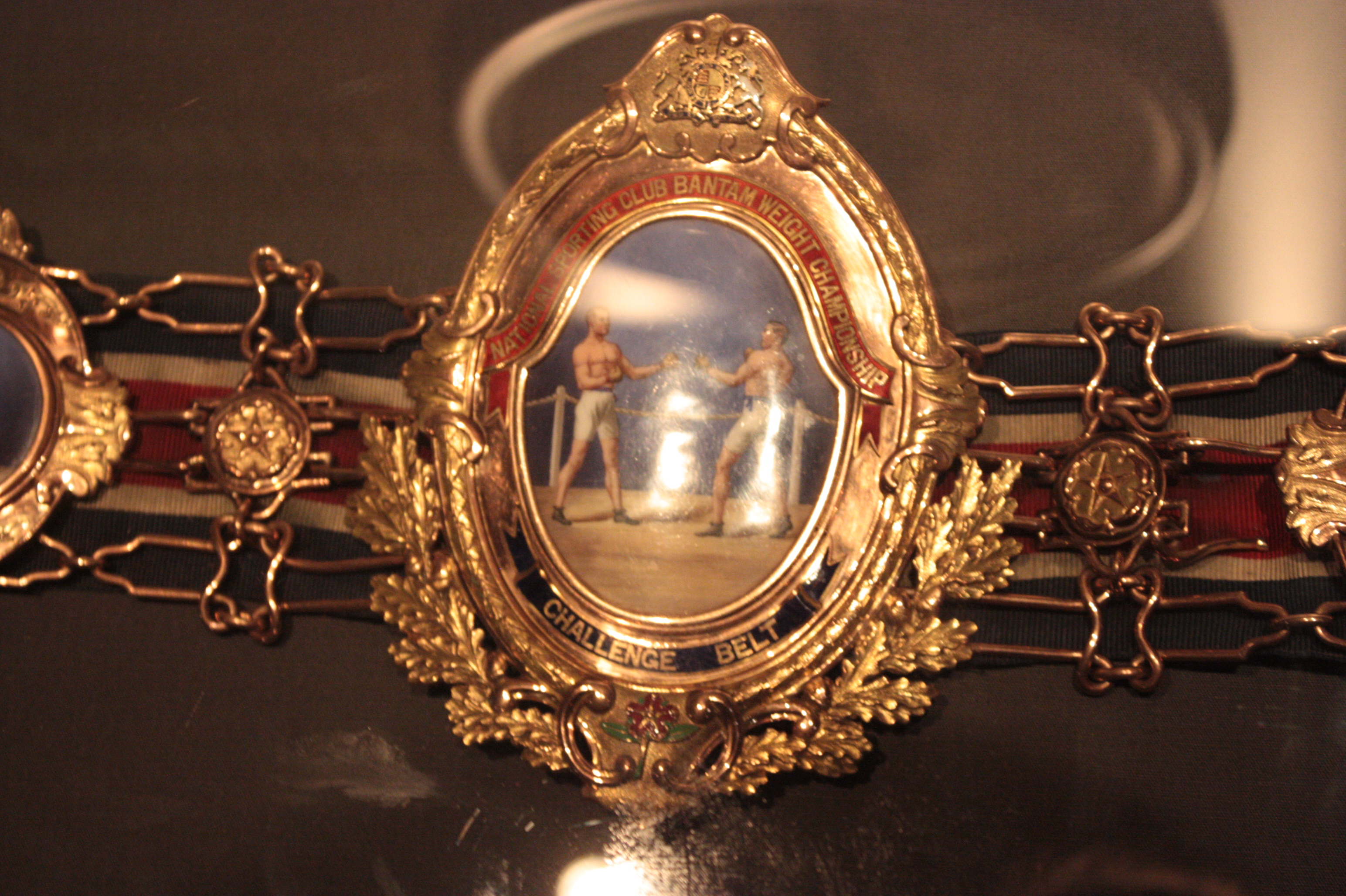

The early belts included gold examples. Later belts changed in material and design, and Thomas Fattorini became the manufacturer associated with the modern trophy.
In 2022 the Board described Fattorini as having produced the belt for many years.
The object changed.
Its place in British championship boxing endured.
The Belt And The Gate
Prestige does not erase history.
The championship structure that brought order to British boxing also determined who was permitted to enter it.
For part of the twentieth century, the colour bar prevented Black fighters from receiving recognition as British champions.
That meant exclusion from the championship system represented by the Lonsdale Belt.
The fighters denied that opportunity belong to a larger history than this article can properly tell.
But they cannot be removed from the history of the belt.
A championship trophy reflects the authority that awards it.
The Lonsdale Belt represented British boxing's highest domestic recognition.
For a period, British boxing did not make that recognition equally available.
Both facts belong in its history.
Henry Cooper — Three Belts
If outright ownership represents sustained domestic achievement, nobody embodies it more completely than Henry Cooper.
Cooper did not merely win a Lonsdale Belt outright.
He won three.
No boxer has equalled that achievement.
In July 1993, all three were sold at auction for £42,000.
The oldest, a gold belt made in 1936 and first won by Tommy Farr, had become Cooper's outright after his 1959 victory over Brian London. His other two outright belts followed in 1964 and 1967.
The sale demonstrates what “outright” means in the most literal sense.
They were his property.
A championship achievement had become a possession that could be kept, inherited or sold.
Why Outright Still Matters
The Board later tightened the conditions for outright ownership.
Its own published history records the change from three championship wins to four, including one mandatory contest. Current regulations also prevent a boxer receiving more than one outright belt in the same division.
The effect is simple.
Winning a British title is difficult.
Owning the belt is harder.
The modern rule demands more than reaching championship level once. A boxer has to remain successful within the British championship structure long enough to satisfy the Board's conditions.
That is why fighters still talk about winning the belt outright as an ambition in its own right.
It marks work completed.
A domestic chapter made permanent.
The First Woman
For more than a century, the belt's story was exclusively male.
That changed on 6 May 2023.
Lauren Price defeated Kirstie Bavington by unanimous decision in Birmingham in the inaugural British female welterweight championship contest.
Price became the first woman to receive a Lonsdale Belt.
More than 113 years separated Freddie Welsh's first contest for one and Price's.
The object survived.
The definition of who could compete for it changed.
That, too, is part of what a historic sporting trophy records.
Why Does It Still Matter?
A British championship is not a world championship.
That is precisely why the Lonsdale Belt does not need to pretend to be something else.
It belongs to a defined championship tradition.
There are fighters who move beyond domestic level before earning one outright.
There are world champions who never owned one.
That diminishes neither achievement.
Sporting accomplishments do not have to sit in one universal hierarchy.
The Lonsdale Belt measures something particular.
Domestic supremacy.
Continuity.
Defence.
Time.
And, eventually, ownership.
The Object Itself
The physical belt matters because boxing has always understood symbolism.
A champion does not need gold, silver or enamel to prove a result.
The record can do that.
The object does something different.
It makes achievement tangible.
That is why old Lonsdale Belts survive in museums and collections.
Why they appear at auction.
Why families preserve them.
Why fighters speak about owning one rather than merely holding one.
A championship can become a line in a record.
A Lonsdale Belt can be held in your hands.
More Than A Belt
The simplest description is that the Lonsdale Belt is the challenge trophy awarded for the British boxing championship.
Correct.
Incomplete.
It began as part of an attempt to bring authority to championship claims.
It became a physical symbol of recognised British championship status.
Its rules created a distinction between holding the trophy and earning the right to own it.
Its history also carries the exclusions of the system that controlled access to it.
Its administration, design, materials and conditions have changed.
The meaning attached to it has endured.
To hold the Lonsdale Belt is to hold the British championship trophy.
To win one outright is to leave with part of British boxing history as your own property.
That is why, more than a century after Freddie Welsh first fought for one, fighters still want it.
From the MBB Research Desk
Historic sporting objects are easy to romanticise.
The better question is what they meant at the time.
The Lonsdale Belt has never been only one thing.
A championship trophy.
An instrument of authority.
A valuable object.
A reward for sustained achievement.
A gate through which some fighters were once prevented from passing.
And, for those who satisfy the conditions for outright ownership, a piece of boxing history that ceases to belong to the championship and begins to belong to them.
The rules changed.
The belt changed.
British boxing changed.
The history remained attached to it.
Boxing history. Judged on the evidence.
Boxing history. Judged on the evidence.
Read more evidence-led boxing history and reference features from the MBB Research Desk.
Explore Boxing History