Two Days in Good Company
An afternoon with boxing friends, an Italian evening in Cannock, and a reminder of what makes the sport special.
There are people in boxing whose names you have known for most of your life. You remember their fights, their victories, sometimes their defeats. You read about them, watch the old footage and gradually build a picture of who they were and what they achieved.
Then, occasionally, you find yourself sitting across a table from them.
That is a rather different experience.
On Thursday 12 November 2026, I joined Scott Murray for lunch with Ray 'Boom Boom' Mancini, Tommy Taylor and Joey Eye. The following evening, my youngest son Will accompanied me to Scott's The Italian Job II at Bar Sport's Premier Suite in Cannock, where Mancini and Joey were appearing alongside Joe Calzaghe.
Two very different occasions, separated by little more than twenty-four hours. One an informal afternoon among a handful of people, the other a full evening of boxing entertainment.
Both reminded me of something I have come to appreciate increasingly through my work with Murphy Boxing Books.
The history of boxing belongs to the people who lived it. And sometimes the best way to understand that history is simply to listen.
Thursday — Around the Table
Scott Murray had invited me to lunch. I had not known him particularly long, although we had already met on several occasions, and I was looking forward to spending some time with him.
I knew who would be there, of course. That was part of the attraction.
Ray Mancini was a name I had grown up with. The former WBA lightweight champion from Youngstown, Ohio, whose career had been shaped in part by his father Lenny's unfinished ambitions. Ray had won the world title in 1982, fulfilling a dream that the Second World War had interrupted for his father nearly forty years earlier.
There is a family story behind that championship which makes it rather more than another entry in the record books.
Joey 'Eye' Intrieri was another man whose career deserved far more recognition than it generally received outside boxing circles.
A Philadelphia boxing man through and through, Joey had spent decades working at the highest levels of the sport. A former professional fighter, he became one of boxing's most respected cutmen, working with world champions and earning recognition through multiple Hall of Fame honours.
He had also taken that experience into the film industry, appearing in boxing films and working as an actor and technical adviser on productions including Creed. There are not many people who can move comfortably between the corner of a world championship fight and a Hollywood film set, but Joey had done both.
And then there was Tommy Taylor.
Tommy had been a professional light-heavyweight during the 1980s, winning the Midlands Area title and sharing the ring with some formidable opponents. His record included a points victory over a young Johnny Nelson, who would later become WBO cruiserweight champion, and a British title eliminator against Mark Kaylor at the Royal Albert Hall in 1987.
His boxing career alone would have provided plenty to discuss.
But Tommy had another life altogether.
He had worked as a commercial diver, undertaking demanding underwater jobs at depths exceeding 100 metres. Cable laying, welding and the sort of work that requires a particular combination of skill, nerve and physical endurance.
He spoke about spending two days in a decompression chamber, not as some extraordinary ordeal, but as an ordinary part of the work.
I asked him what it was like.
His response was wonderfully matter-of-fact. You lived in the chamber anyway, he explained.
I had been imagining two days of confinement. Tommy was describing a normal working arrangement.
It was one of several occasions that afternoon when I was reminded how much more there can be to a fighter's life than the years recorded in BoxRec.
Scott made the introductions and then, for much of the afternoon, left us to ourselves. He was never far away, but he did not feel the need to direct the conversation or remain at the centre of it. He joined us properly for the final part of lunch.
That suited the afternoon perfectly.
There was no interview taking place. I had no prepared questions, no recorder running and no intention of turning a friendly invitation into work.
We simply talked.
Boxing naturally provided much of the conversation, but it wandered wherever the stories took it. Old friends, old fights, people they had known and places they had been. Some of it was fascinating, some of it hilarious, and a fair amount of it will remain exactly where it belongs.
Around that table.
Ray and Joey were particularly entertaining together.
They have the familiarity of men who have known one another long enough to recognise a story before the other has finished its opening sentence. More than once, one would begin recounting something about the other, only for the subject of the story to look across at me with an expression of weary resignation.
I remember Joey doing precisely that while Ray was talking.
He didn't need to say anything. His face said enough.
Later, when Joey had his turn, Ray returned the favour.
There was also the revelation that Ray, despite being born under the star sign Pisces, could barely swim. He seemed to find the contradiction as amusing as the rest of us did.
And then there was Spider.
The young barman had somehow acquired a new name courtesy of Joey, who repeatedly addressed him as Spider throughout the afternoon.
Anyone familiar with Goodfellas will understand the reference immediately. Unfortunately, the young man had never seen the film.
He had absolutely no idea why we were laughing.
Eventually somebody explained the connection, along with the recommendation that he really ought to watch it. Whether he subsequently did, I have no idea, but I suspect he will remember that particular group of customers for some time.
It was an afternoon full of moments like that.
Nothing staged. Nothing rehearsed. Just people enjoying one another's company.
I have interviewed fighters, researched their careers and spent countless hours trying to establish what really happened in particular bouts or periods of boxing history. That work matters to me. It is the foundation of what I am trying to build.
But there is another kind of understanding that comes from being in the company of people who were there.
The way they remember one another. The details that have stayed with them. The stories they find funny fifty years later.
Those things rarely appear in official records.
What struck me most about Thursday, however, was not simply the quality of the company or the stories being told.
It was how naturally I was included.
These were men whose careers I knew, whose achievements I respected and whose names carried considerable weight in the sport. Yet there was never a sense that I was an outsider being politely accommodated.
They spoke to me, laughed with me and treated me as though I were an old friend.
I don't mean that as some grand claim of friendship. We had spent an afternoon together, nothing more. But there is a difference between being welcomed into someone's company and merely being allowed to occupy a chair.
I felt genuinely welcome.
That was worth more than any photograph or autograph.
I left grateful to Scott for the invitation, and looking forward to the following evening.
I had no idea quite how enjoyable that would turn out to be.
Friday — The Italian Job II
The following evening brought a change of setting, although several of the faces were familiar.
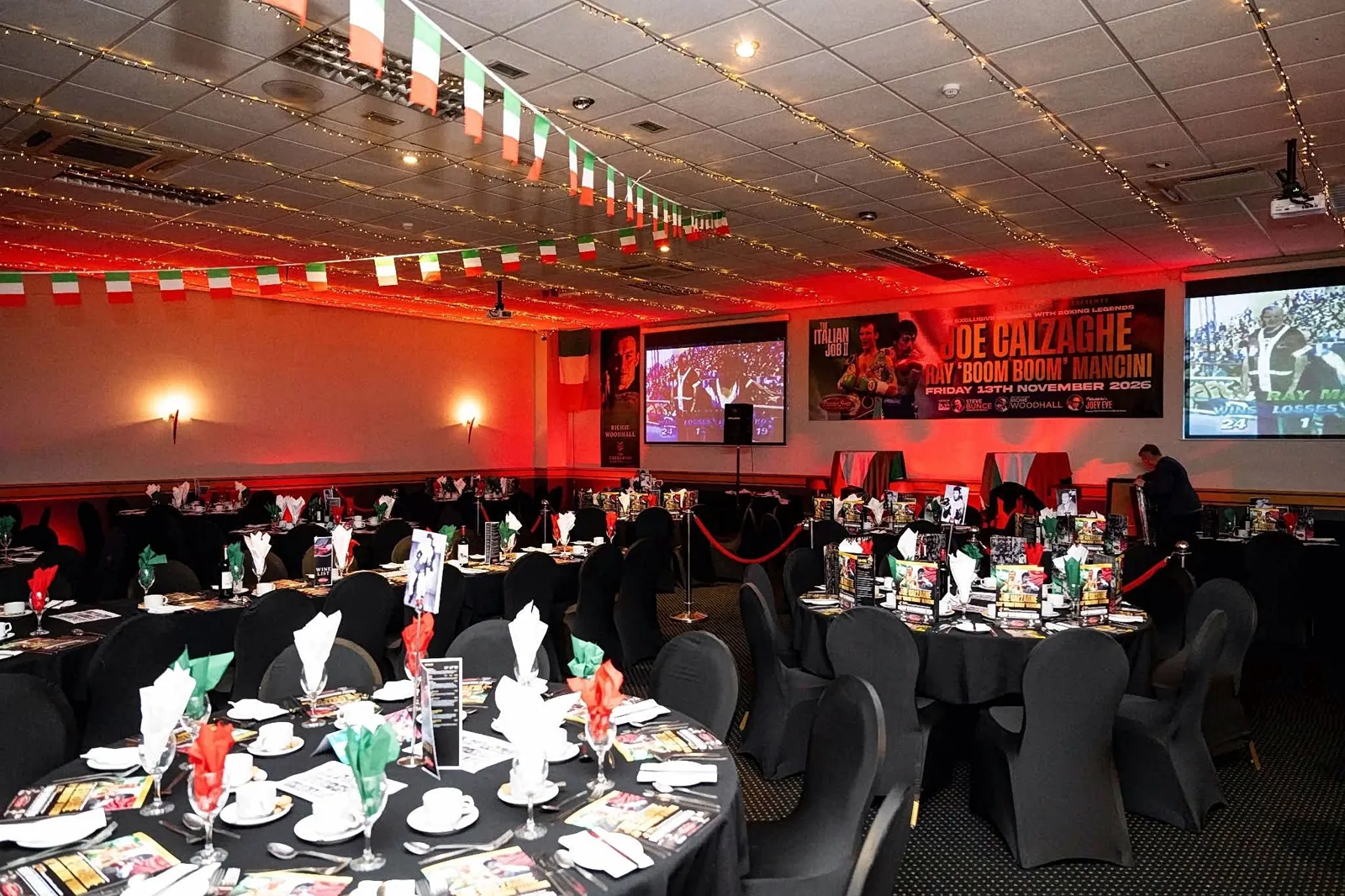
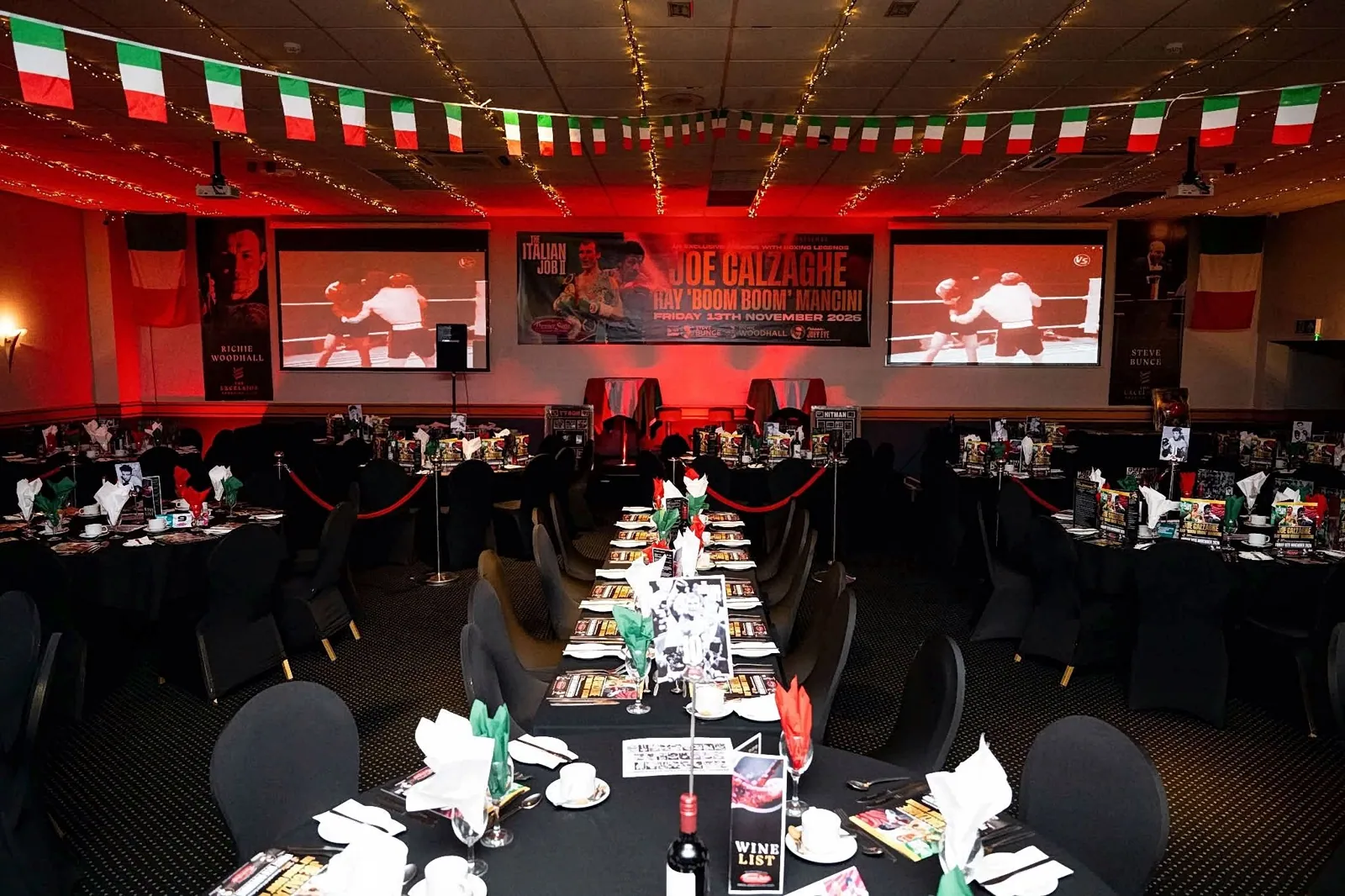
Scott Murray's The Italian Job II took place at Bar Sport's Premier Suite in Cannock on Friday 13 November, with Joe Calzaghe and Ray Mancini as the principal guests, joined by Joey Eye.
The evening was billed as an offer you couldn't refuse, borrowing from The Godfather, and the Italian theme was carried throughout the venue.
Flags hung overhead, the room was decorated for the occasion, and a programme of food, music, interviews and entertainment had been arranged around three men whose contributions to boxing had taken very different forms.
This time I had Will with me.
He has accompanied me to a number of boxing evenings over the years, and he enjoys meeting the fighters and collecting photographs and autographs. He is also remarkably comfortable in company, something I have always admired about him.
We arrived to find that our table was immediately beside the entrance doors.
As positions go, it was difficult to improve upon.
The guests were arriving, the room was filling and there was the familiar sight of boxing people greeting one another, stopping for photographs and catching up with old acquaintances.
Joey was waiting nearby to be introduced when he spotted me and called me over for a handshake.
A little later, Ray stopped on his way into the room to greet me personally.
It was a lovely continuation of the previous afternoon, particularly with Will there to see it.
Then the evening began properly.
An Italian Evening
One of the things Scott and his team do well is make an evening feel like an occasion rather than simply a meal followed by a guest speaker.
The Italian theme was more than decoration.
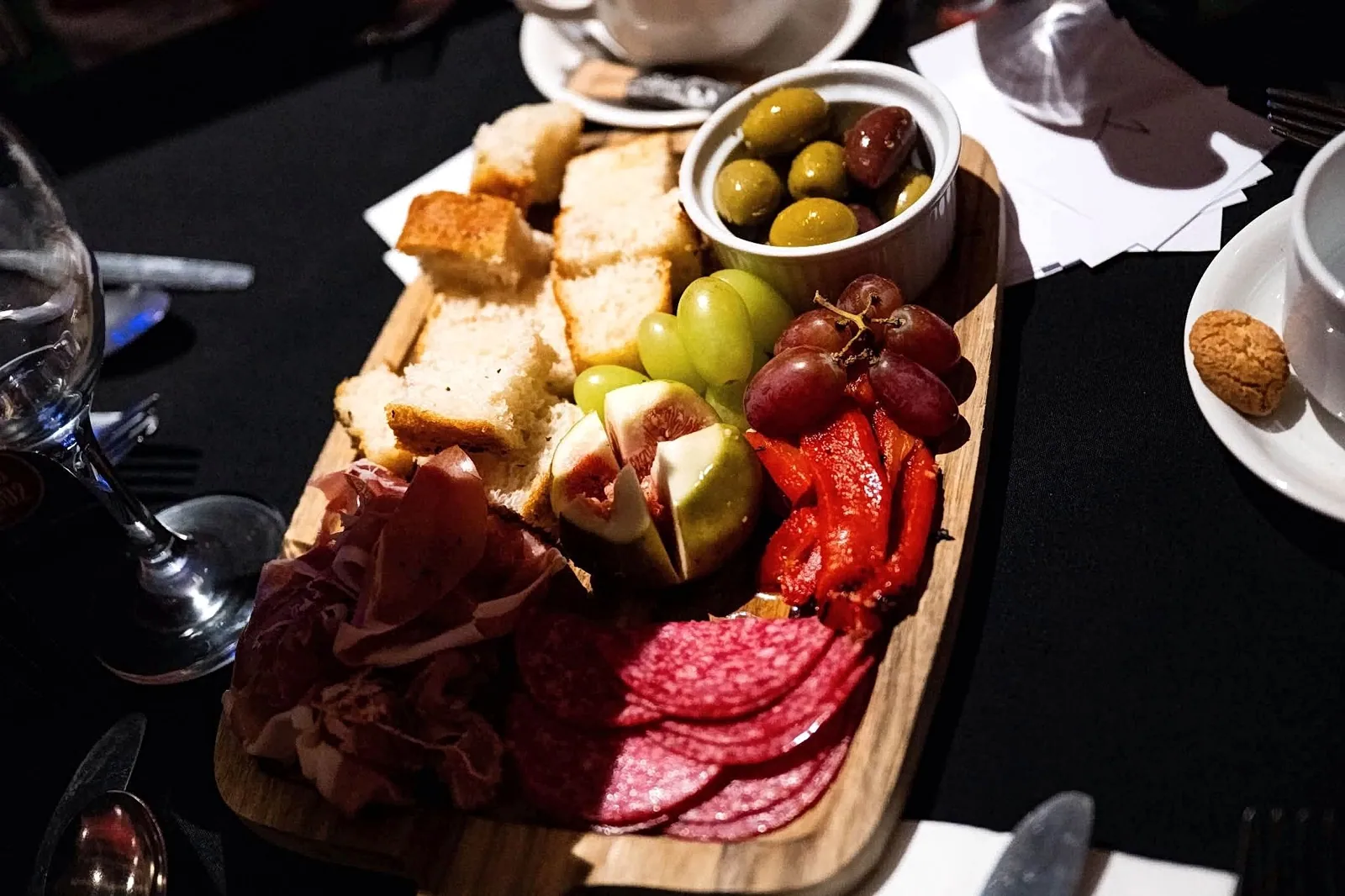
Guests were welcomed with drinks and canapés, followed by an antipasto selection of cured meats, olives, roasted peppers, sun-dried tomatoes, fruit and rosemary focaccia.
There was minestrone soup with toasted ciabatta, then Tuscan-style chicken with sun-dried tomato and garlic sauce, Parmesan polenta, courgette and asparagus. A vegetarian gnocchi option was also available.
Dessert was tiramisu, followed by Italian coffee and biscotti.
The food was excellent.
I mention it because these things matter. People had paid to attend an evening of entertainment, and the meal was a substantial part of what they were paying for. It would have been easy to treat it as something to get through before the boxing personalities took the stage.
That was not the case.
The meal was properly presented, the menu suited the occasion and the whole thing felt considered.
Music added to the atmosphere, with a singer performing Italian-American classics and songs associated with the Rat Pack era.
It was an appropriate choice. The music, the flags, the food and the references to Italian-American culture all fitted together without becoming overdone.
Around the room were familiar figures from boxing, some well known nationally and others whose contributions had been made over many years at club and regional level.
That mixture is one of the things I particularly enjoy about these gatherings.
World champions and former professionals may provide the headline attraction, but boxing has always depended on far more people than those whose names appear on championship belts.
Trainers, seconds, promoters, club officials, volunteers and supporters all have their place in its history.
An evening like this brings many of them together.
Joey Eye — The Man in the Corner
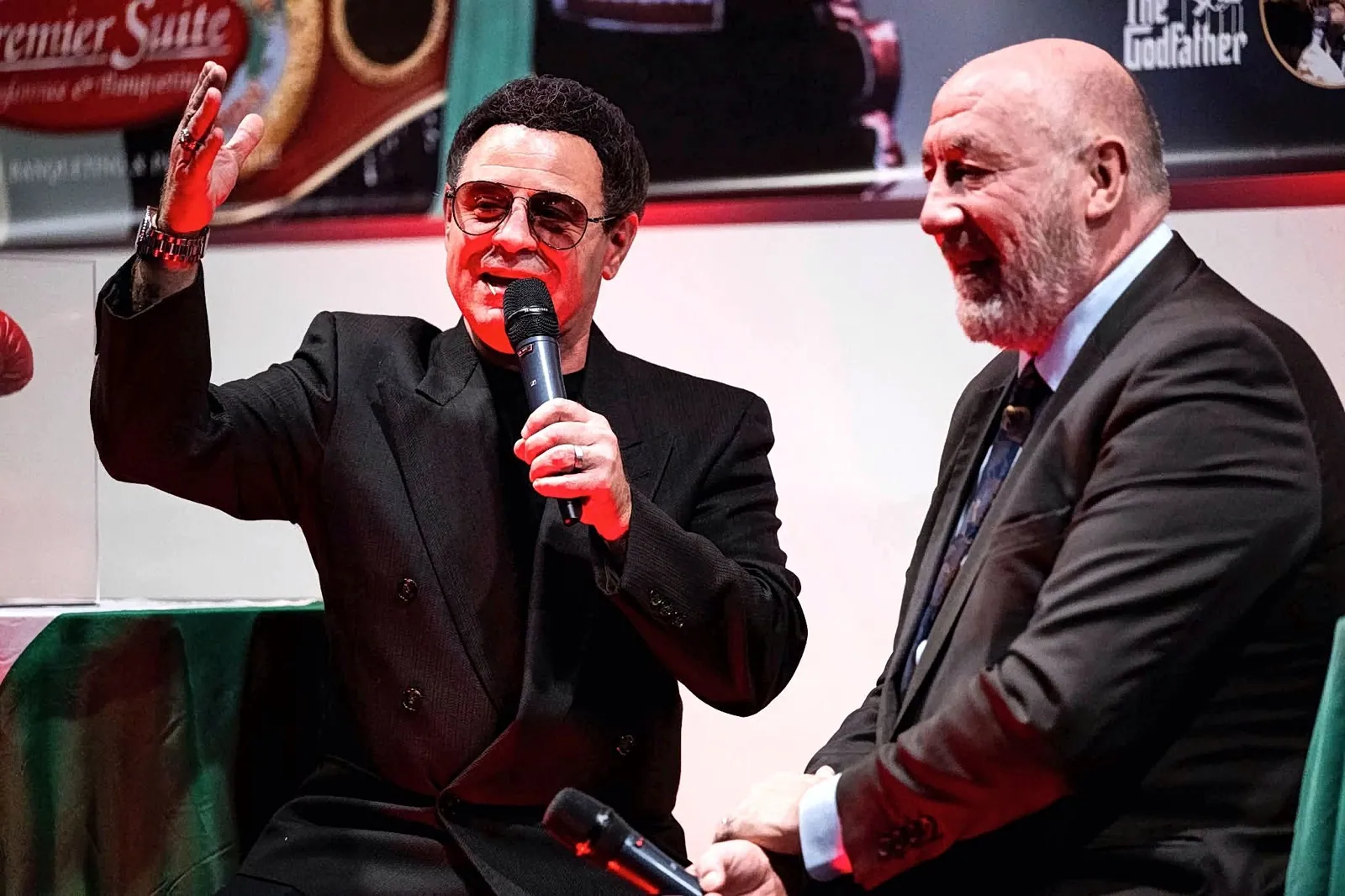
The first featured interview was conducted by Steve Bunce, who took to the stage with Joey Eye.
It was a fitting way to begin.
Most boxing audiences are accustomed to hearing from the fighters themselves. Their careers are recorded in wins, losses, titles and memorable contests. We know when they became champions and, usually, when their reigns ended.
The men who work in their corners are less easily measured.
A cutman's contribution might last only a minute between rounds, yet that minute can determine whether a fight continues.
The ability to assess an injury, control bleeding, reduce swelling and keep a fighter composed is a skill developed through years of experience. There is little room for hesitation and no opportunity to ask for extra time.
Joey has spent much of his life doing precisely that.
His career has taken him through world championship boxing, training camps and the film industry, where his knowledge has helped bring a measure of authenticity to fictional fights.
There is a certain irony in that. Hollywood can recreate almost anything, but when it wants boxing to look convincing, it still turns to people who have spent their lives doing the real thing.
Bunce was well suited to the conversation.
He knows the sport, understands the personalities and has a natural enthusiasm for the stories that exist beyond the obvious headlines.
Joey's appearance gave the audience a chance to hear from a man whose working life had largely been spent just outside the ropes, close enough to influence events but seldom the person receiving the applause.
It was good to see him receiving some of it.
Calzaghe and Mancini
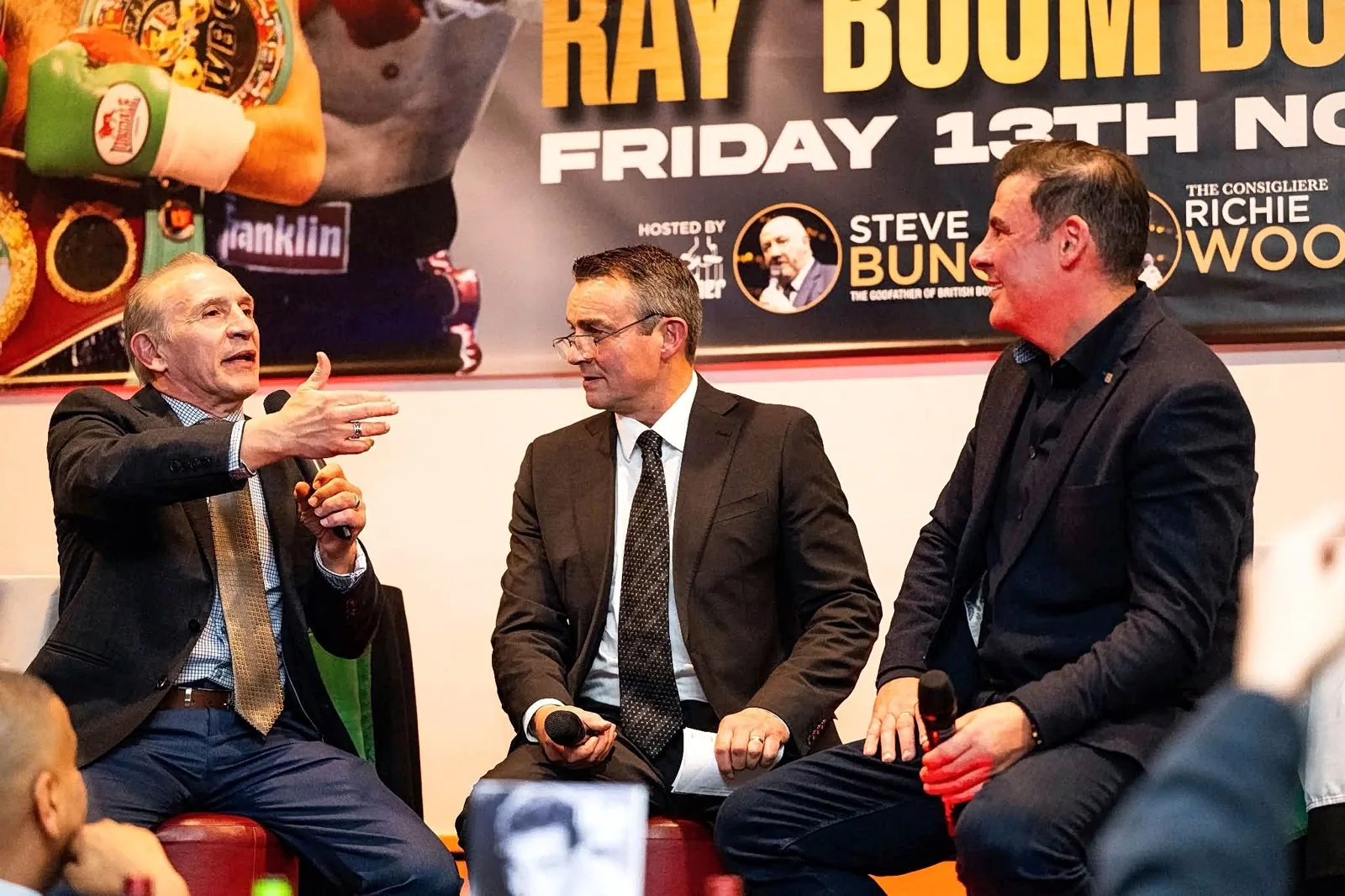
The main interview brought Joe Calzaghe and Ray Mancini together, with Richie Woodhall taking over the questioning.
There was a considerable amount of boxing history sitting on that stage.
Calzaghe retired undefeated in 2008, having won all 46 of his professional contests. His reign as WBO super-middleweight champion lasted more than a decade, and his victories over Jeff Lacy and Mikkel Kessler remain among the defining performances of British boxing in the modern era.
He subsequently moved to light-heavyweight, defeating Bernard Hopkins and Roy Jones Jr before bringing his career to an end.
Ray's career had followed a very different path.
Born into a boxing family in Youngstown, Ohio, he had grown up with the story of his father Lenny, a talented lightweight whose own championship ambitions had been interrupted by military service during the Second World War.
When Ray won the WBA lightweight title in 1982, it was the fulfilment of something that had begun a generation earlier.
He fought with a relentless, crowd-pleasing style and became one of the most recognisable American fighters of the decade.
The two champions represented different eras and different approaches to the sport, but both had experienced the particular pressures that come with being a world champion.
Woodhall was an excellent choice to bring them together. He and Calzaghe had once been opponents, meeting for the WBO super-middleweight title in 2000. That shared history gave their conversation an easy warmth, with none of the distance you might expect between two men who had fought one another.
A former WBC super-middleweight champion himself, Richie understands what happens inside the ring in a way that someone who has never fought professionally cannot entirely replicate.
He knows what it means to prepare for a championship contest, to make decisions under pressure and to carry the expectations that accompany success.
At one point Joe joked that he had been in danger of making a habit of going down early in fights. Richie gave him a playful punch on the arm and replied, 'You could have done that when you fought against me!' Joe, Ray and Richie all laughed, as did the audience. It was a genuinely warm moment, and one that said rather more about the friendship and respect between former opponents than any formal introduction could have done.
The interview was accompanied by footage of the fighters' careers, showing memorable contests and achievements as the conversation developed.
I particularly enjoyed that element.
We have all watched old boxing footage, often many times over. The fights become familiar, the results known, the significant moments part of the sport's collective memory.
But watching those moments while the men responsible are sitting in front of you adds something.
The footage shows what happened.
The people who were there can explain what it felt like.
For Will, it was also an opportunity to see something of the careers that had made these men famous long before he was born.
There is a tendency to think of boxing history as belonging to those of us old enough to remember it. It doesn't. The stories remain just as important when they are being heard by a new generation.
That is how they survive.
More Than the Main Event
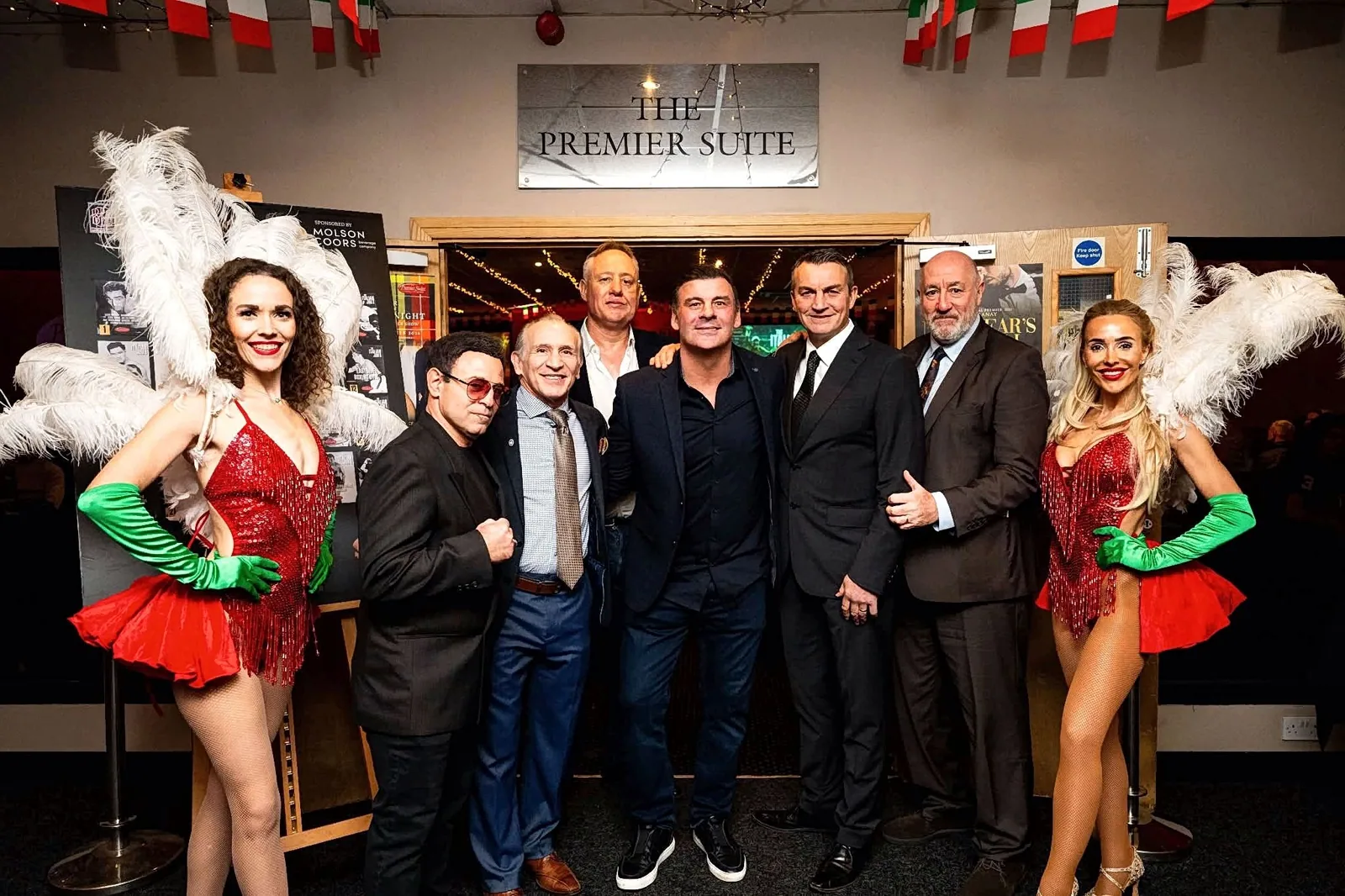
The formal interviews were the centrepiece of the evening, but there was plenty happening around them.
A competition challenged the tables to identify a collection of Italian boxers from photographs.
This was precisely the sort of thing I ought to have been good at.
Our table did rather well, finishing second after leading at one stage. We missed only a handful, which I thought was a respectable performance.
Until I remembered one of the answers.
Lenny Mancini.
Ray's father.
A man whose story I had been discussing and whose son was sitting in the same room.
I remembered him just after our sheet had been collected.
There are times when being a boxing historian is of absolutely no assistance whatsoever.
The auction followed, with boxing memorabilia attracting bids from around the room. As usual, some of the items went beyond what I was prepared to spend, although I did manage to secure two 16-by-12-inch photographs, one of Joe Calzaghe and the other of Ray Mancini.
They would prove rather more memorable than I expected.
There was also bingo towards the end of the evening, with £200 going to the winner.
It might seem an unlikely addition to a night featuring two world champions, but it worked. There was a relaxed, good-humoured atmosphere throughout, and the audience was clearly enjoying itself.
Scott had put together an evening with enough variety to keep people entertained without losing sight of the boxing that had brought everyone together.
Familiar Faces
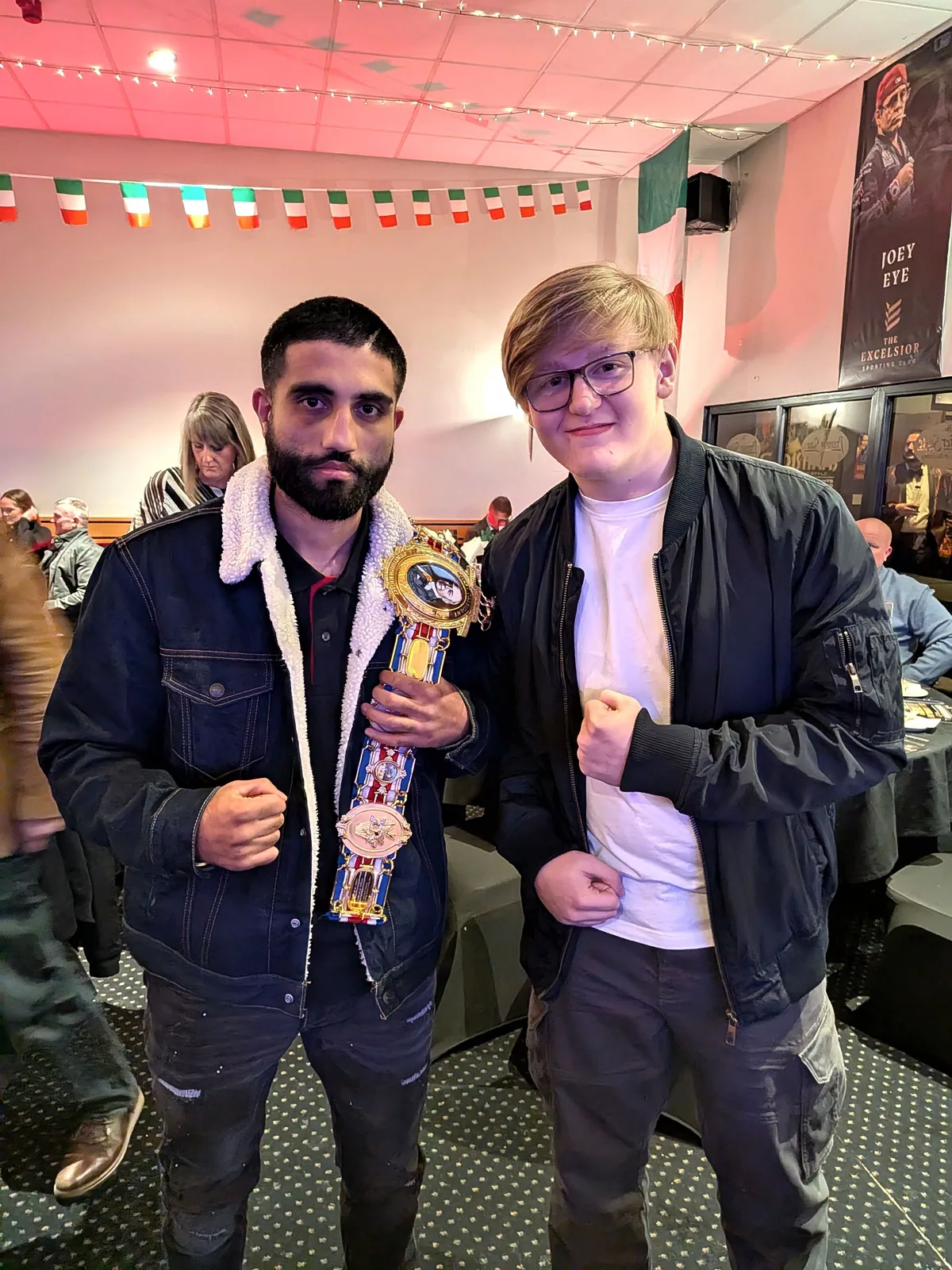
One of the pleasures of the evening was seeing people I had come to know through my work.
Will had his photograph taken with Gully Powar, who was happy to pose with his championship belt.
Richie Carter of Wolverhampton Boxing Club was also there, and I saw a number of other familiar faces from the Midlands boxing scene.
While walking towards the queue for our professional photographs, I passed Jon Pegg, who was standing with Sam Eggington and several others preparing for a group picture.
Jon stopped me.
He told me he had just been talking about me, then turned to Sam and explained that I was the man who had written the article.
Sam recognised me immediately.
Both were generous in what they said about the piece, and we exchanged handshakes before I continued on my way.
It was a brief moment, but an encouraging one.
I have spent much of this year building Murphy Boxing Books, researching, writing and trying to produce work that does justice to the people and histories involved.
There is a considerable difference between publishing something and knowing that the people concerned have read it.
Hearing directly that they appreciated the work meant a great deal.
I also exchanged a few words with Richie Woodhall at the top table later in the evening. We have met and spoken at previous events, and he greeted me warmly, as he has done before.
There was no formal meeting with Richie on this occasion, just a familiar greeting between people who have crossed paths a few times.
Those small encounters are becoming an enjoyable part of attending these events.
A Photograph for Will
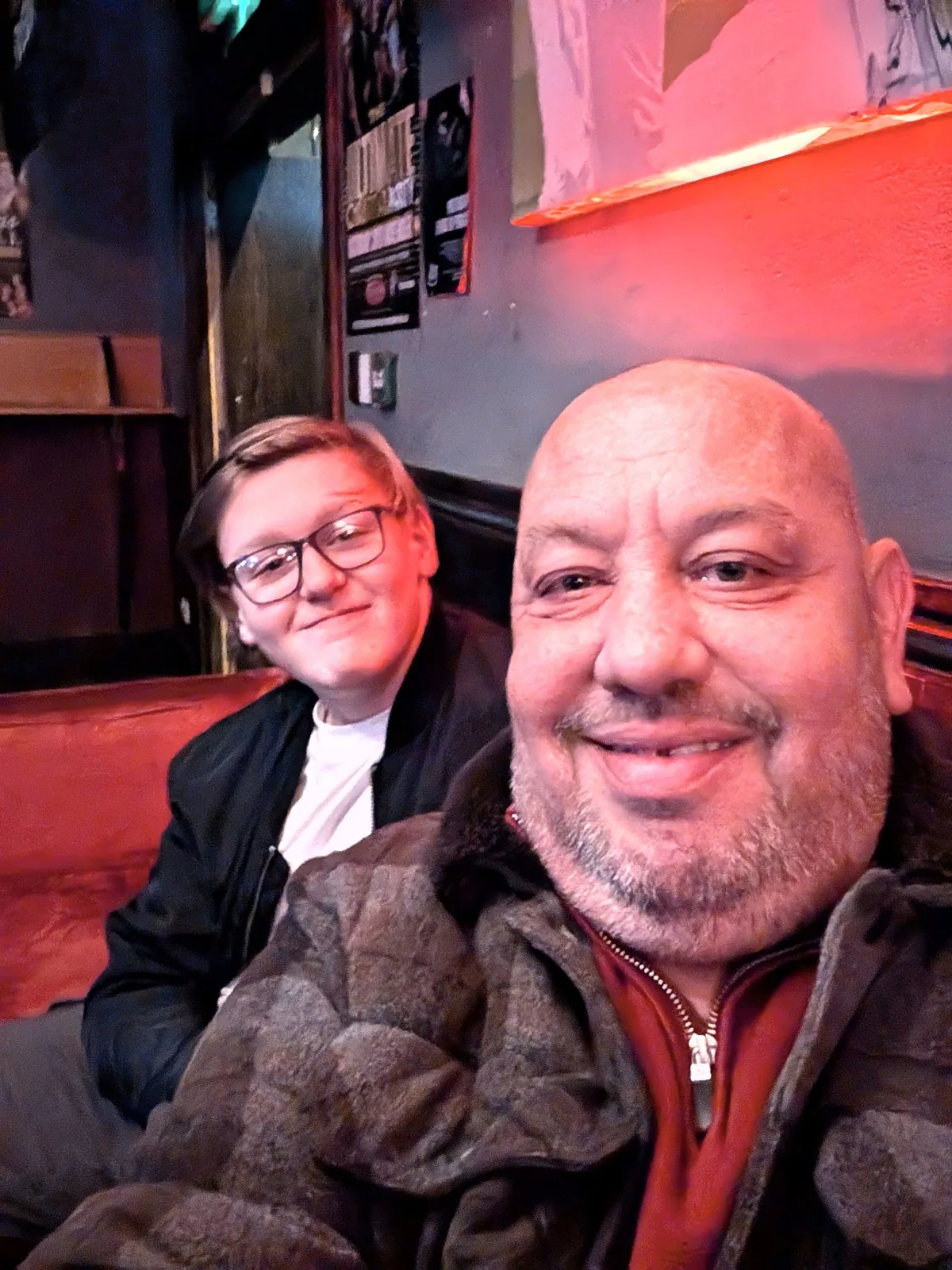
The most unexpected moment of Friday came towards the end.
I had collected the two photographs from the auction and, as the top table was nearby, decided to ask Joey whether he would sign them for Will.
He agreed immediately.
Unfortunately, the only pen I could find was an ordinary biro.
Joey signed the Calzaghe photograph but was clearly not satisfied with the result.
He told me to wait, produced a chrome Sharpie and proceeded to do the job properly.
While signing, he joked with Ray about whether he ought to put his signature straight across Ray's face.
It was typical Joey, and very much in keeping with the humour of the previous afternoon.
Joe Calzaghe was there too, and I managed to exchange a few words with him. Nothing profound, just a pleasant conversation, but he was friendly and engaged with me when he could easily have been concentrating on the many other people seeking his attention.
Once the photographs were signed, I thanked everyone and began to walk away.
Then I felt someone take hold of my arm.
It was Joey.
He called me back, opened his personal wallet and took out a small photograph from a bundle he was carrying.
It was a signed five-by-five-inch picture of himself.
"For your boy," he said, handing it to me.
That was it.
No fuss, no audience, no reason to do it beyond a simple act of kindness.
Will had gone to the toilet at the time, so he missed the exchange itself. But when I returned and gave him the photograph, he was absolutely delighted.
Within minutes he was taking pictures to send to his mates.
I have no idea how many photographs Joey has signed during his career. It must run into thousands. To him, handing one over may have been the most ordinary thing in the world.
To a sixteen-year-old who had spent the evening surrounded by boxing champions and personalities, it was something rather special.
And that is the part I will remember.
Not the value of the photograph, which is beside the point, but the fact that Joey had thought of him.
The Man Who Brought It Together
It would be easy to finish this account with the personal moments, because naturally those are the things that stay closest to me.
But that would overlook the reason we were all there in the first place.
Scott Murray had organised another excellent evening.
The food was good, the entertainment varied and the interviews gave the audience a chance to hear from people who had made genuine contributions to boxing history.
Steve Bunce brought his knowledge and personality to the conversation with Joey Eye. Richie Woodhall handled the discussion with Calzaghe and Mancini, using footage of their careers to bring the stories to life.
The Italian theme ran throughout the evening, from the flags and music to the meal itself. There was an auction, a competition, a little bingo and plenty of opportunity for guests to meet the people they had come to see.
It was a well-organised night with a friendly atmosphere, and the sort of event that reminds you how much affection there still is for the sport and the people who have been part of it.
Scott deserves credit for that.
It takes work to bring these occasions together, and considerably more to make them feel as relaxed as this one did.
I managed to thank him briefly as we were leaving, although there was hardly time for a proper conversation. By then the evening was drawing to a close and people were making their way home.
I will thank him properly.
What Stays With You
When I began researching and writing about boxing, I was interested primarily in the history.
I still am.
The records, the forgotten fighters, the families, the old photographs and newspaper reports. The stories that have survived and those that are in danger of disappearing.
That remains the purpose of Murphy Boxing Books.
But the work has brought something else into my life that I had not particularly anticipated.
People.
Over these two days I had listened to a former world champion talk about his life, heard a professional fighter describe an extraordinary career beneath the sea, laughed at stories shared by men who had known one another for years, and watched my son enjoy an evening in the company of some of boxing's most recognisable figures.
I had also been reminded that the people whose names appear in the record books are not defined entirely by what they achieved inside the ring.
They are fathers, friends, storytellers and, occasionally, very generous men with chrome Sharpies.
There is one final thought.
On Thursday, I was treated like an old friend by men I had only recently come to know. On Friday, I watched those same men extend that warmth to my son.
Neither owed us anything.
That is what made it matter.
Will came home with his photographs, his memories and a story he was already sharing with his friends.
I came home with a few more stories of my own, some new friendships to nurture, and a renewed appreciation of the people who make boxing what it is.
The sport has given me plenty to write about.
Over those two days, it gave me something more personal.
And I am grateful for it.
Photo gallery
More photographs from The Italian Job II. Click any photograph to view it in full.


Gallery credit note: photographs numbered Scanned_20261116-0132-25 to -39 were supplied as Darren J. Murphy’s own photographs; other event images were shared by Scott Murray.
Photographs taken by Darren J. Murphy are credited accordingly; other event images shared courtesy of Scott Murray / The Excelsior Sporting Club. Original photographer credit pending confirmation.